

Foundations
Part of Accounting services foundations for the 2027 MTD shift
Recording accounting services demand signals
Record accounting services demand signals from directory enquiries, match customer needs to service scope and separate demand from provider readiness.
Accounting services demand signals are only useful if they can be counted the same way twice. Enquiries, callbacks and proposals measure different things, and one customer can appear in several of them. A signal register fixes the definitions first, so figures can be compared from month to month without flattering the practice.
For a business using an accounting and bookkeeping service directory, the practical question is which service matches its need. Routine bookkeeping, record clean-up and MTD preparation are distinct requests, not interchangeable accounting enquiries. Directory teams and listed practices can use the register below to route requests by service scope, record quality and digital access.
What to take away
- Compare signals at the same funnel stage, never visits against retained clients.
- Count work units and review time, not just organisations.
- Give enacted changes more weight than announcements and record uncertainty in its own field.
- Report seasonality so one busy tax or filing month is not read as growth.
- Retire a signal that does not reliably produce a defined need.
Set the register fields before the first entry
Fix the register fields first, because a signal recorded without a definition cannot be compared later. Each entry needs a source, a geography, a customer definition, a service hypothesis, a volume measure, a conversion stage and the capacity it would need.
| Field | What to write | Example |
|---|---|---|
| Source | Where the signal comes from, with its date | HMRC guidance or a Companies House page |
| Customer definition | Who is affected and who is not | Sole traders and landlords over the stated threshold, not every sole trader |
| Service hypothesis | Work a competent provider could deliver | Data clean-up before digital records |
| Volume measure | The unit being counted | Work units, not organisations |
| Conversion stage | How far the signal has progressed | Callback, diagnostic, proposal, retained |
| Uncertainty | What could change the signal | Exemptions, live rules, a later deadline |
Weight an enacted change above an announcement. HMRC says sole traders and landlords with qualifying income over £30,000 for 2025 to 2026 enter Making Tax Digital for Income Tax from 6 April 2027, subject to live rules and exemptions. That is a dated, defined group, so it scores higher than a rumour.
Companies House shows the opposite case. Its guidance states that from 1 April 2028 all companies must file their accounts using commercial software. The change was not introduced in April 2027. A signal that points to the wrong year still belongs in the register, with its uncertainty field filled in.
Source entries from directory enquiry forms, callback logs and completed diagnostics, keeping each source labelled separately. Give each enquiry a reference so repeat contacts do not become new customers. Check a listed provider's service description against the recorded need and confirm any unclear scope before routing the enquiry.
For each enquiry, confirm the triggering event, the records available and the requested work directly with the customer. Verify regulatory claims against the linked HMRC or Companies House guidance, recording its update date and the relevant cohort or commencement date. A published rule establishes an obligation for the affected group; a verified enquiry establishes that a customer is seeking help.
Compare signals at the same funnel stage
Website visits, callback requests, completed diagnostics, accepted proposals and retained clients each measure something different. Compare signals only at the same stage, and record the stage on every entry so a strong top of the funnel is not mistaken for demand.
| Stage | What it shows | What it cannot show |
|---|---|---|
| Website visit | Interest in a topic | Whether the visitor fits the customer definition |
| Callback request | A stated need | Whether the work is deliverable |
| Completed diagnostic | Record quality and scope | Willingness to pay |
| Accepted proposal | Agreement to the scope | Whether the client stays |
| Retained client | The service fitted the customer | Whether the signal repeats |
Link each record to a date, service, source and customer type without storing unnecessary personal information. The date matters most, because a signal tied to an event should be read against that event, not the calendar year.
Where the customer definition is still loose, an audience research method can sharpen it. Use semi-structured interviews with a common interview guide, then thematic coding to group answers by the service needed.
Count work units, not organisations
One customer can produce several enquiries, so count the work, not just the organisation. A client who needs MTD preparation, record clean-up and monthly bookkeeping is three work units and one organisation. Counting organisations alone overstates the number of customers and understates the capacity needed.
Add review time to each unit so the register shows capacity, not just volume. Corrective work belongs on its own line, priced and scheduled apart from routine bookkeeping, so neither party mistakes remediation for a normal monthly service. Bank reconciliation backlogs, mixed personal and business spending or missing invoices may create that corrective demand.
Segment by record quality and digital access
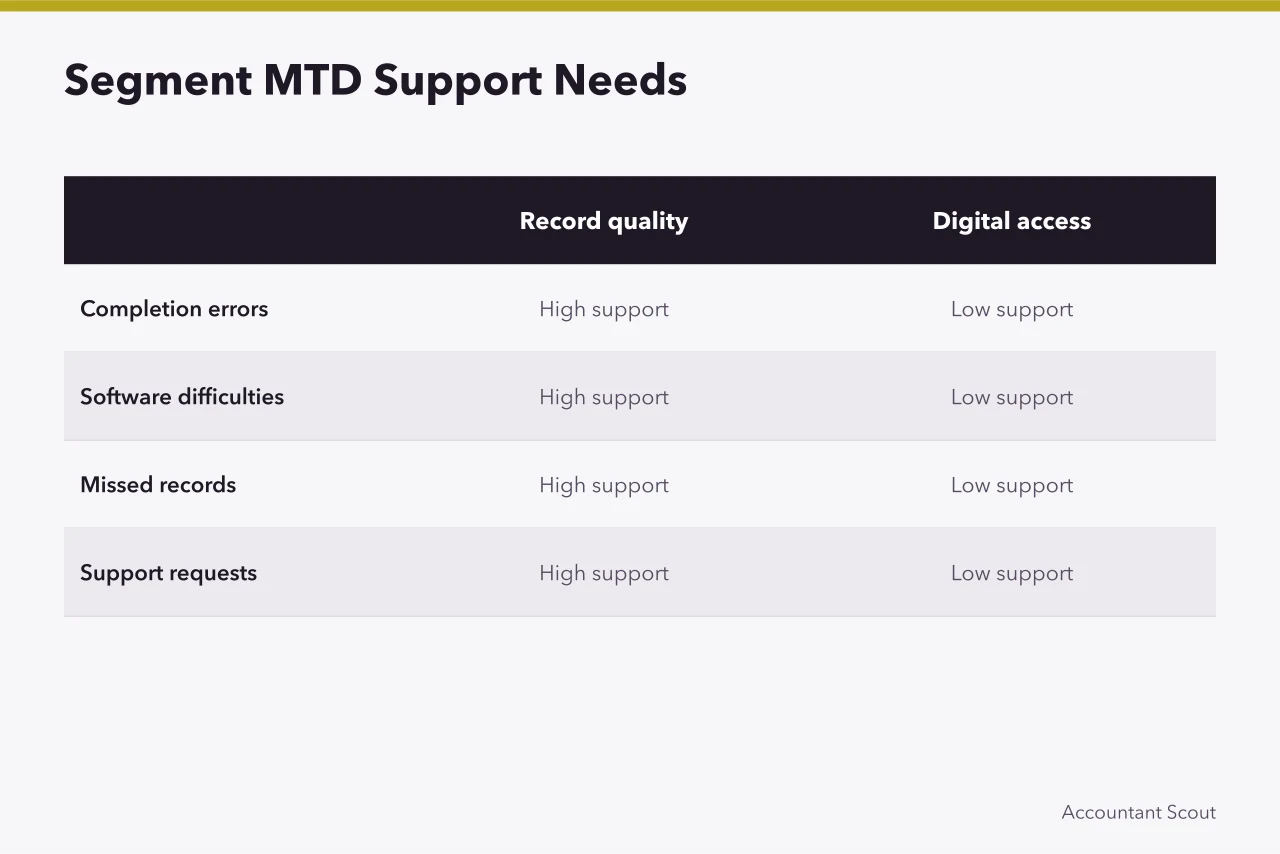
Existing users of a new rule show where a service is really needed. The first mandatory MTD cohort began in April 2026 under the published threshold.
Their completion errors, software difficulties, missed records and support requests are signals in their own right. That first cohort is separate from the group with qualifying income over £30,000 entering from 6 April 2027 described above.
Segment those signals by record quality and digital access rather than assuming one onboarding package suits everyone. Log each request against its segment, so the register shows which group needs help and not just that help is wanted. A client with clean records and full digital access needs a different service from one with neither.
Keep your own readiness work out of the count
Registration and filing reforms create work inside the practice, but they are not customer demand. HMRC's professional tax-agent registration guidance explains a staged requirement for paid advisers who interact with HMRC for clients. Log that work in a separate column from customer enquiries.
Track Tax-Agent Registration
- Affected staff
- Applications
- Permissions
- Service interruptions
Registration is neither customer demand nor an HMRC endorsement of the practice.
Company filing reform works the same way: in 2027 it may appear as readiness assessment, data mapping and software selection. Check the advertising rules before publishing any claim that implies a 2027 statutory deadline. Those preparation tasks are distinct from the commercial-software filing requirement dated 1 April 2028 in the Companies House guidance cited above.
Report seasonality and verify events
Report each signal with its season, because tax and company deadlines can make one busy month look like permanent growth. Compare a month with the same point in the previous cycle where one exists, and label spikes that follow a deadline.
Business events need the same care. First employment, VAT registration, incorporation, a funding round or overseas sales can change required records. Capture the event, the affected obligation and the deadline. A newly incorporated company is not automatically a client: count only a verified enquiry or engagement.
Test a signal with a bounded offer
Test a signal with a bounded offer and documented qualification questions before acting on it. Record declined and unsuitable cases as well as wins, because the losses show where the signal stops predicting a real need. Use the same questions with every enquiry so answers can be compared.
After a pilot, speak with customers who bought, declined and abandoned. Ask what event prompted action, which alternative they used and what evidence they needed before deciding. Structured customer interviews keep those conversations comparable. Write the answers into the register against the original signal.
Retire a signal when it stops earning its place
Retire a signal when it does not reliably produce a defined need, or when the practice cannot serve the resulting cases safely. If interest is high but record quality makes delivery uneconomic, the business has found a workflow problem, not a proven market opportunity.
Before you act
- Fix the register fields before the first entry.
- Record the funnel stage on every entry.
- Count work units and review time, not only organisations.
- Keep practice readiness work apart from customer enquiries.
- Label seasonal spikes against the same point in the previous cycle.
- Retire a signal that does not reliably produce a defined need.
Common questions
Why compare demand signals at the same funnel stage?
Visits, callbacks, diagnostics, proposals and retained clients measure different things. Comparing across stages makes a busy top of the funnel look like demand. Record the stage on every entry and compare like with like.
How should a practice count one customer with several needs?
Count the work units and the review time as well as the organisation. A customer needing MTD preparation, clean-up and monthly bookkeeping is one organisation but several pieces of work to schedule and price.
When should a signal be retired?
When it does not reliably produce a defined need, or when the practice cannot serve the resulting cases safely.