

Costs and pricing
Accounting services costs: how to budget fees, VAT and extras
Budget accounting services in England using defined scope, comparable fee models, VAT assumptions, client effort, scenarios, ROI evidence and controls.
Accounting service prices in England should be compared through a common scope, not an unsupported national average. Entity type, activity, transaction volume, employees, record quality, taxes, frequency, advice, risk and deadline pressure all change the work. A meaningful budget combines external fees, software, internal effort, VAT cash, transition and uncertainty.
This guide uses official and professional-body material checked on 5 September 2026. The worked figures are fictional arithmetic, not quotations or predictions. Tax rates, professional rules and individual terms can change, so reopen the linked sources and obtain qualified advice for the particular engagement.
What to take away
- Compare accounting quotes through one common scope rather than an unsupported national average.
- Entity type, transaction volume, record quality and deadlines all change the work and the price.
- Fixed, recurring, time-based, unit, hybrid and contingent fees place uncertainty in different places.
- VAT is a cash and cost questionnot all VAT is recoverable, so budget net, VAT cash and irrecoverable amounts.
- External fees are only part of the budget; internal effort, software, transition and uncertainty also count.
Start with the decision the service must support
Write down why the organisation is buying accounting help. It may need reliable statutory work, regular bookkeeping, payroll, better management information, specialist tax advice or a clean handover from another provider. These are different purchases.
Name each legal entity and person included. A company engagement does not automatically cover a director's return, a separate property activity or another company. Map the accounting period, tax registrations, payroll scheme, banks, currencies, software and filing obligations.
Then list deliverables and frequency. For example:
Start with the decision
- weekly or monthly transaction processing and reconciliation;
- monthly payroll and year-end employee documents;
- quarterly VAT work or other periodic tax activity;
- monthly management reports and a review meeting;
- annual accounts and company tax return;
- individual returns for specified people;
- company secretarial filings named in the schedule;
- advice, enquiry support and projects under separate authority.
State who prepares, reviews, approves and submits. Describe what the client must provide and by when. If the source records arrive late, contain personal spending or lack evidence, the task and price may change.
HMRC's standard for agents says agents within its scope should make engagement terms clear, particularly how they will be paid, agree terms before acting and provide relevant information before and during the relationship. The standard does not replace law or professional-body duties.
Choose workload measures that a client can verify
"Small business" is not a unit. Build the quote around drivers that can be counted consistently:
Workload measures by service
Service
- Bookkeeping
- Transactions, accounts, documents
- Payroll
- Employees, frequencies, starters, leavers
- VAT
- Registrations, schemes, periods, adjustments
- Accounts
- Entities, ledgers, schedules, estimates
- Tax
- Taxpayers, income sources, claims, disposals
- Reporting
- Frequency, entities, dimensions, forecasts
Possible workload evidence
- Bookkeeping
- Payroll
- VAT
- Accounts
- Tax
- Reporting
Choose workload measures
| Service | Possible workload evidence |
|---|---|
| Bookkeeping | Transactions, accounts, documents, currencies, integrations |
| Payroll | Employees, pay frequencies, starters, leavers, benefits, pensions |
| VAT | Registrations, schemes, periods, adjustments, cross-border activity |
| Accounts | Entities, ledgers, schedules, estimates, group relationships |
| Tax | Taxpayers, income sources, claims, disposals, elections, enquiries |
| Reporting | Frequency, entities, dimensions, forecasts, meeting and revisions |
Define how the count works. An imported bank line, reversed entry and duplicate receipt should not silently become three different units unless the pricing schedule says so. Use a representative historic period and add an explicit forecast.
Record condition deserves its own assessment. Sample several periods, not only a tidy month selected for the proposal. Note unreconciled balances, missing invoices, duplicate contacts, suspense items, unsupported journals and tax-code inconsistencies. Decide whether correction is included, capped or separately estimated.
Complexity is more than volume. Fifty similar domestic sales may require less judgement than five unusual transactions. Ask bidders to identify specialist assumptions, dependencies and work they would decline or refer.
Compare six common fee structures
The charging method determines where uncertainty sits. Price the same twelve-month scenario under each proposed arrangement.
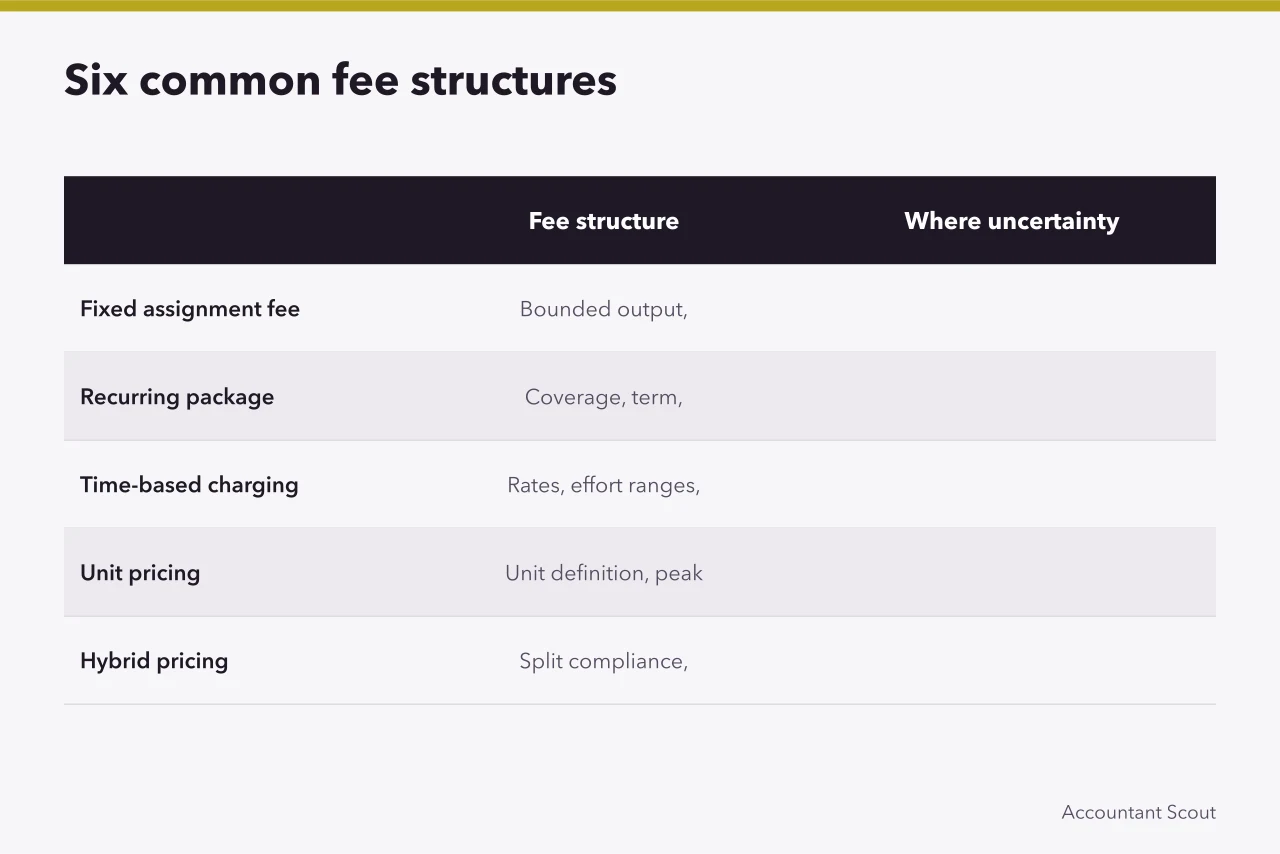
Fixed assignment fee
A fixed sum can work for defined accounts, a return, migration or other bounded output. Specify the entity, period, records, revisions, client input, review and acceptance. Add a written variation process. Without those controls, "fixed" may only describe the original assumptions.
Recurring package
A monthly subscription can spread cash and support continuing work. Establish whether it covers all named services or is a payment on account to be reconciled later. Check start and end dates, minimum term, annual adjustment and unused capacity.
Time-based charging
Hourly and daily rates adapt to uncertain investigations or advice. Require rates by role, initial effort ranges, progress points and approval before exceeding a limit. The engagement still needs expected outputs and quality review; accumulated time is not a substitute for a finished service.
Unit pricing
A fee per employee, transaction, document, property or entity can follow volume. Define the unit and bands, then stress-test peak activity. Check whether corrections, rejected submissions and inactive records count.
Hybrid pricing
A combined model might put predictable compliance on a recurring fee, variable processing on units and novel advice on time. It can reflect the work closely, but the invoice needs enough detail to prevent overlap. State which method takes precedence.
Contingent or outcome-related charging
Payment linked to a refund, saving, transaction or other result can create conflicts and may be prohibited or constrained for particular work or relationships. Define the outcome, baseline, calculation, timing, reversal and treatment of third-party decisions. Obtain qualified legal and relevant professional review rather than assuming that an outcome fee is acceptable.
For members and firms in its scope, ICAEW's current fee information helpsheet describes the fee basis, written quote information, payments on account, requests for breakdowns and handling of exceeded estimates under its Code of Ethics. Verify the current code and the provider's own professional body; not every accountant or bookkeeper follows ICAEW rules.
Normalise quotations before comparing totals
Create one spreadsheet row for every charge and use the same evaluation period. Capture:
Normalise every quotation
- Provider, service and covered entity
- Charging basis and volume assumption
- Net amount and payment date
- VAT shown separately
- Onboarding, migration and clean-up
- Software and connected services
- Additional-work rates and authorisation threshold
Ask each bidder to complete the same template. If a practice cannot price an uncertain item, require the rate, likely range, decision point and evidence needed to refine it.
Do not compare a net monthly headline with a gross annual estimate. Remove introductory discounts from the steady-state column and show them once in cash flow. Record contract periods and notice dates. If one quote bundles software, identify its edition, allowances and future cost.
Handle VAT as a cash and cost question
GOV.UK's VAT rate guidance states that the standard rate is 20% for most goods and services at the fact-check date. The actual supply and provider circumstances determine the invoice treatment, and rates can change.
For budgeting, maintain three distinct amounts:
Three VAT amounts to budget
- 20%standard VAT rate on most goods and services
- 1net supplier charge
- 2VAT cash paid
- 3irrecoverable VAT as economic cost
Do not presume full recovery merely because the customer has a VAT number. Exempt activity, partial exemption, non-business use and other facts can affect the position. Ask the appropriate adviser to review material assumptions.
Tax deductibility is another calculation. HMRC's guidance on legal and financial costs for the self-employed describes qualifying categories and exclusions for the population it addresses. A limited company, partnership and individual can require different analysis. A potential tax effect should not be used to make a service look cheaper before entitlement is established.
Include the costs that sit outside the quote
The business itself spends time on accounting. Estimate gathering, explanations, corrections, approvals, meetings, actioning advice and resolving supplier issues. Use an internal cost basis that the organisation can defend, and keep it separate from supplier cash.
Common omissions include:
- historic correction before the routine service starts;
- extra entities, directors, registrations and tax returns;
- payroll events and benefits beyond a basic headcount;
- document or transaction allowances;
- additional software users, storage and interfaces;
- specialist technical or legal input;
- investigation and enquiry support;
- late information and accelerated work;
- parallel running during provider or system change;
- final work, notice, export and successor handover.
The Small Business Commissioner's contract guide gives general UK business prompts on written terms, parties, scope, payment, duration, termination and disputes. Use it as orientation, not tailored legal advice. Reconcile the proposal, engagement, service schedule and data terms before accepting the price.
Use a worked budget with visible assumptions
Consider a fictional England company planning a twelve-month service. It enters these assumptions:
Worked budget with assumptions
| Budget item | Illustrative calculation | Amount before VAT |
|---|---|---|
| Core accounts and tax package | 12 months x £650 | £7,800 |
| Payroll service | 12 months x £140 | £1,680 |
| Quarterly reporting meetings | 4 x £275 | £1,100 |
| Opening clean-up | Fixed estimate | £1,250 |
| Separate software | 12 months x £75 | £900 |
| Additional advice allowance | 10 hours x £150 | £1,500 |
| Internal staff preparation | 40 hours x £32 | £1,280 |
External charges total £14,230 before VAT. Internal time adds £1,280, producing an illustrative combined resource estimate of £15,510 before considering VAT cash or recoverability.
If all external charges carried 20% VAT, gross supplier cash would be £17,076. That is a mechanical scenario, not a conclusion about the real invoices. The model should substitute each provider's tax treatment and show any irrecoverable portion.
The buyer should then produce at least two alternatives. In a pressure case, transaction and employee growth may move the package into a higher band, while late records add clean-up. In a favourable case, the opening ledger may need less correction. Give every difference a written driver rather than applying an unexplained contingency percentage.
Test the budget against uncertainty
Build base, plausible pressure and severe but credible cases. Vary the quantities that matter: records, staff, entities, advisory hours, delay, migration complexity and internal time. Add contract price changes only according to the proposed terms.
Approval threshold for out-of-scope work
Will the task exceed the stated amount or delay a deliverable?
New estimate and client acceptance
Proceed within existing authority
Identify the peak cash month. Annual affordability can hide a difficult concentration of onboarding, year-end work, software renewal and tax payments. The latter are not accounting service costs, but the finance plan still needs to distinguish and schedule them.
Set approval thresholds. For example, require a new estimate and client acceptance when an out-of-scope task may exceed a stated amount or delay another deliverable. Decide who can trade service quality, timing or scope and what they cannot waive.
Track commitments as well as invoices. Once work is authorised, it belongs in the forecast even if the bill has not arrived.
Estimate value without overstating causation
Separate reasons for buying the service:
Estimate value
- meeting a necessary compliance obligation;
- avoiding duplicated work or external contractor spend;
- releasing staff capacity for evidenced use;
- improving decisions through timely, relevant information;
- reducing a defined operational or tax risk.
Calculate net return as attributable evidenced benefits less incremental cost. Divide that net benefit by incremental cost only when a percentage is genuinely useful. Keep compliance necessity and risk exposure visible rather than forcing both into a speculative cash value.
HM Treasury's quality in impact evaluation guidance concerns public-policy evaluation, but its distinction between observed outcomes and causal effects is valuable here. Business results may also change because of demand, pricing, staff, software or seasonality.
Define the baseline before appointment. Track comparable periods and other interventions. If ten hours a month are reportedly saved, document the old and new task, who recorded time and how the released capacity was used. A forecast benefit should remain labelled as such until evidence exists.
Run low, central and high benefit cases. Show the break-even level of usable time or avoided cost. A negative narrow return does not necessarily reject a necessary compliance service; it means the buyer should compare compliant alternatives on total cost, quality and residual risk.
Control invoices and changes during the year
At the start of the relationship, turn the quote into a service calendar. Attach each recurring payment, unit allowance and milestone to the corresponding deliverable. Give client responsibilities owners and dates.
Change record process
- Request and reason
- Affected entity and work
- Fee basis and deadline
- Dependencies and approval
- Confirm in durable form
Review early invoices line by line. Match the service, period, quantity, rate, VAT and authority for extras. Classify variance as price, volume, scope, timing, error or unplanned advice. Correct ambiguous recurring descriptions before they become normal practice.
Operate a change record containing request, reason, affected entity, work, fee basis, deadline, dependencies and approval. Confirm material changes in a durable form before work begins where circumstances allow. An urgent deadline may require fast authority, but it should not erase the record.
Compare actual client effort with the estimate. Repeated missing information may call for a new capture process, training or a changed service, not simply a higher contingency next year.
Review the provider and budget together
Price is only one part of value. Sample completed files, corrections, response quality, deadline evidence, data handling and advice follow-through. A low fee accompanied by recurring rework can consume internal capacity and increase risk.
At each quarter or suitable service interval, update:
Quarterly provider and budget review
- Actual and forecast external cost
- VAT cash and irrecoverable amounts
- Internal hours and causes
- Volume against bands
- Approved changes and disputes
- Service failures and remedial work
- Evidenced benefits and attribution confidence
Discuss likely excess before the work is complete. ICAEW's helpsheet says, within its scope, that where an estimate or quote will be exceeded the firm should inform the client in advance, try to provide a new estimate and seek consent to continue. The exact duty for another provider requires its applicable terms and rules.
Budget for exit before signing
Ask what the organisation receives on termination: ledger exports, transactions, attachments, working papers where entitled, tax records, submissions, acknowledgements and status of unfinished work. State format, timing, charge and read-only access.
Map upcoming payroll, VAT, accounts and tax deadlines through the notice period. Name the person who will revoke access, redirect communications, reconcile the last invoice and brief the successor.
Some work may remain chargeable after regular payments stop. Clarify finalisation, answering successor queries, data extraction and storage. Avoid making payment disputes the only control over essential business records; obtain legal advice on rights and obligations in the actual case.
Apply a final buying checklist
Before approval, confirm that:
Final buying checklist
- All entities, services, periods and outputs listed
- Record quality and volume assumptions evidenced
- Exclusions and additional-work rates visible
- Quotations use same period and VAT convention
- Software and internal client work in model
- Base, pressure and exit cases affordable
- Invoice, renewal and termination controls have owners
The strongest accounting services budget is reproducible. Another reviewer can trace every total to a quantity, rate, tax assumption and source, then see which event would change it. That is more useful than a broad claim that one monthly package is cheap, premium or best for England.
Before you act
- Write down why the organisation is buying accounting help.
- Name every legal entity and person included in the engagement.
- List deliverables, frequency and who prepares, reviews and submits.
- Price the same twelve-month scenario under each proposed fee structure.
- Normalise every quote into one spreadsheet using the same evaluation period.
- Separate net charges, VAT cash and irrecoverable VAT in the budget.
Common questions
What should a budget for accounting services include beyond the provider's fee?
A meaningful budget combines external fees, software, internal effort, VAT cash, transition and uncertainty. The business also spends time on gathering, explanations, corrections, approvals, meetings, actioning advice and resolving supplier issues. Keep that internal cost separate from supplier cash and use a basis the organisation can defend.
How should a client compare fixed, recurring and time-based fee quotes?
Price the same twelve-month scenario under each proposed arrangement. For fixed fees, specify the entity, period, records and revisions. Add client input, review and acceptance, plus a written variation process. For recurring packages, check whether the fee covers all named services or is a payment on account. For time-based work, require rates by role and approval before exceeding a limit.
Can a business assume it will recover all VAT charged on accounting fees?
No. Do not presume full recovery merely because the customer has a VAT number. Exempt activity, partial exemption, non-business use and other facts can affect the position. Maintain three distinct amounts: net supplier charge, VAT cash paid, and VAT that is not recoverable and remains an economic cost.
In this guide
- What accounting services cost once scope, records and frequency are pinned downEstimate accounting service costs in England from scope, records, frequency, risk, software and change, with an illustrative budget and VAT check.
- Fixed, recurring, hourly or hybrid? What each accounting fee model rewards and risksCompare fixed, recurring, time-based, unit, hybrid and outcome-linked accounting fees in England by scope, incentives, uncertainty and control.
- Tracking an accounting services budget in England against filing datesTrack an accounting services budget in England against HMRC and Companies House dates: actual, committed and forecast cost, variance causes, client time, VAT.
- Accounting services return on investment: costing the benefits and testing causationEstimate accounting service return on investment using a baseline, full costs, evidenced benefits, attribution limits, scenarios and a decision threshold.
- Accounting services hidden costs: ten questions to askTen questions to put to an accountant before you accept a quote, so each hidden cost is marked included, excluded or dependent on facts, in writing.